Parcel Consolidation and Repacking: When Do They Save Money?
Consolidation saves money only when the shipping reduction exceeds added warehouse, packing and waiting costs. Repacking can help when unnecessary packaging makes dimensional weight high. Neither guarantees savings. Compare the same delivery service before and after, keeping enough protection for the goods.
Published pending human review of service details and native-language copy. Confirm service terms with JTLGO before ordering.
On this page
Consolidation and repacking solve different problems
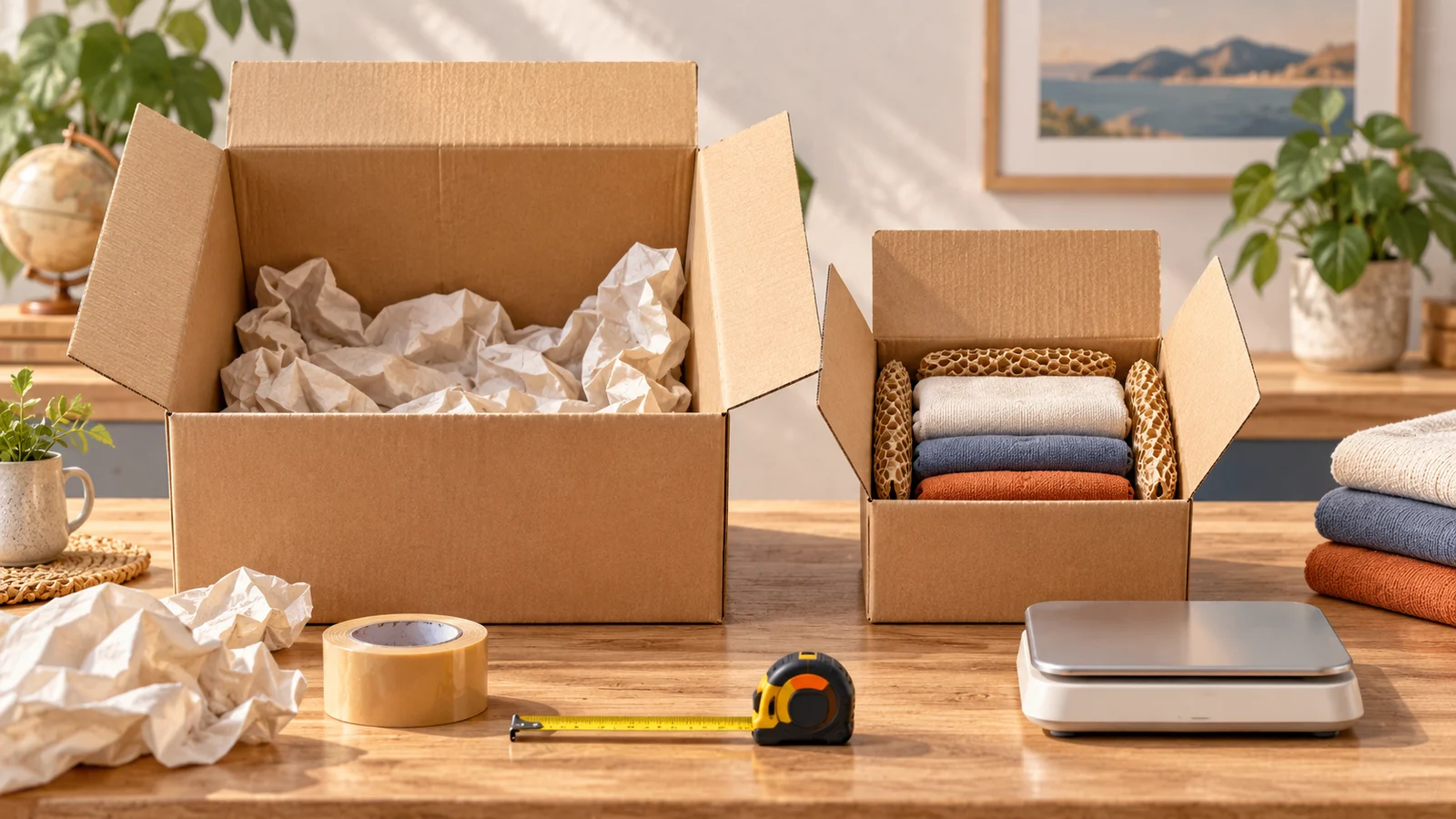
Consolidation groups goods from separate incoming parcels into a planned shipment. Repacking changes the protective or retail packaging. You may need one, both or neither. Removing a seller's oversized outer box is different from discarding a product's retail box, serial label or protective inner tray.
Ask for a packing proposal showing what will be removed, retained and added. Keep buyer-required labels and saleable packaging. Some batteries, liquids or other restricted goods cannot travel on the same route as ordinary cargo; placing them in one box does not remove the restriction.
Find out which weight drives the price
Many parcel and air services compare actual weight with dimensional weight, then bill using their own measurement and rounding rules. FedEx's dimensional-weight explanation illustrates the principle; its published rule is not automatically the rule for a JTLGO route.
Use the divisor in your quoted route. In a hypothetical route only, assume:
Dimensional kg = length × width × height in cm ÷ 6000.
A 60 × 40 × 40 cm carton has 16 dimensional kg. If actual packed weight is 8 kg, the example bills 16 kg before any rounding or minimums. A 50 × 40 × 30 cm replacement carton has 10 dimensional kg; at the same assumed 8 kg actual weight it bills 10 kg. The 6000 divisor is a teaching assumption, not a universal JTLGO policy. Final actual weight can change with new materials.
Hypothetical carton comparison
Hypothetical carton comparison: Original 60 × 40 × 40 cm, Repacked 50 × 40 × 30 cm
Scroll sideways or use the arrow keys to see all columns.
| Carton | Dimensional weight |
|---|---|
| Original 60 × 40 × 40 cm | 16 kg |
| Repacked 50 × 40 × 30 cm | 10 kg |
A transparent break-even example
All prices below are hypothetical inputs, not published warehouse tariffs or freight offers. Assume the same door-delivery service costs USD 6 per chargeable kg, without minimums or extra surcharges, for this calculation only.
Scroll sideways or use the arrow keys to see all columns.
| Option | Freight | Additional packing/handling | Comparable total |
|---|---|---|---|
| Keep original carton | 16 × USD 6 = USD 96 | USD 0 additional | USD 96 |
| Repack | 10 × USD 6 = USD 60 | USD 12 assumed quote | USD 72 |
The example saves USD 96 − USD 72 = USD 24. Break-even added cost is USD 36, the gross freight reduction. If extra handling, materials, waiting and other differences total more than USD 36, repacking loses its price advantage. If added costs total USD 40, the new total is USD 100, or USD 4 more than keeping the original carton.
This table covers costs that differ between options; purchase cost and unchanged charges are omitted from both sides. Confirm they really are unchanged before using this shortcut.
Include warehouse charges and waiting
JTLGO's public fee page, checked on 2026-10-11, separates consolidation planning from physical work. The purchasing service is 10% of product value, minimum USD 10. Physical consolidation/unpacking is listed at USD 0.50/kg chargeable weight; standard materials at USD 0.30/kg volumetric weight, minimum USD 1 and maximum USD 5 per package. Requested repacking after initial packing is listed at USD 3/carton. These dated rules do not turn the invented USD 12 example into an actual quote.
Free storage is 7 days; small-parcel storage after that is listed at USD 0.10/kg/day. Confirm the weight basis, clock start and applicable package category. Ask whether waiting for one seller will trigger paid storage, miss a dispatch cut-off or cause a stockout. Do not assume a purchase restarts the free period for earlier goods.
Hypothetical break-even
Hypothetical break-even: Keep original, Repack with USD 12 extra, Repack with USD 36 extra, Repack with USD 40 extra
Scroll sideways or use the arrow keys to see all columns.
| Option | Comparable total |
|---|---|
| Keep original | USD 96 |
| Repack with USD 12 extra | USD 72; saves USD 24 |
| Repack with USD 36 extra | USD 96; break-even |
| Repack with USD 40 extra | USD 100; costs USD 4 more |
Keep protection in the decision
For glass, electronics or shaped goods, cushioning and separation may matter more than a small freight reduction. Photographs cannot prove a new carton withstands transport. Ask what protection is proposed, whether extra inspection is needed and what insurance or claim terms apply. Avoid compressing items that can deform; preserve evidence of the condition before dispatch.
Send the parcel list, packaging requirements, destination and deadline to request two itemized options. Use Rate & Ship for an initial screen, then approve only after final dimensions, measured weight, route restrictions and complete handling charges are confirmed.
Price per final carton and control packing revisions
Ask whether the quoted route calculates and rounds each carton separately or combines shipment measurements. For separate-carton billing, calculate each carton’s chargeable weight first, then sum; comparing total actual weight with total volume alone can conceal a bulky light carton beside a small heavy one. Minimums, oversized dimensions and special cargo can change the answer. Use the provider’s written rule, not a remembered divisor.
Waiting is a separate decision from repacking. Record each parcel’s receiving date, storage category and latest useful dispatch date. Ask for two alternatives: ship the ready parcels now, or wait for the missing seller. Include the additional outbound handling and freight minimum if split shipping is proposed. Do not treat expected arrival as received stock.
Copyable packing release
Parcel IDs: […]. Retain: retail boxes/serial labels/protective inserts […]. Remove only: […]. Add protection: […]. Keep separate: fragile/heavy/restricted goods […]. Please quote original and proposed packing with carton-by-carton dimensions, actual and chargeable weight, divisor/rounding, work/material/storage lines and delivery scope. Send before/after photos and a final packing list. Approval applies to this packing version only; notify me if carton count, protection or price changes.
If an inbound carton is damaged, document it and the goods before discarding it. A compact final carton is not evidence of satisfactory condition. Photos, packing quality and transport claim eligibility are distinct checks; ask for the relevant claim terms without assuming recovery.
Plan your order
Send your product links, quantities and destination so we can assess your requirements.
Request a parcel and consolidation assessmentSources and references
- JTLGO warehouse fees JTLGO
- JTLGO shipping estimate JTLGO
- Dimensional weight FedEx