Car Parts Compatibility: OEM Numbers, Vehicle Versions and Fitment Checks
To check car parts compatibility, match the vehicle configuration, the exact proposed part and the manufacturer’s application conditions. An OEM number, a similar photo or a seller’s “fits this model” message is a starting point. Obtain catalog evidence and resolve version differences before buying from China, then use warehouse checks to verify that the approved item arrived.
Published pending human review of service details and native-language copy. Confirm service terms with JTLGO before ordering.
On this page
Identify the vehicle before searching the part
Prepare make/model, market, production date, VIN or applicable frame number, engine code, transmission, body style and steering position where relevant. Registration year alone may not identify the production version. Add the installed part’s full label, connector views and symptoms or replacement purpose. A previously modified vehicle may need extra technical review; do not assume its installed part is the original catalog specification.
DENSO’s Europe VIN search uses a 17-character VIN and provides manual-search/support alternatives when it cannot identify the vehicle. Use the catalog covering the actual vehicle market and retain its result and application notes. A failed lookup calls for more evidence, not a guessed vehicle.
Trace the number and every suffix
Copy the original OE reference and the supplier’s own manufacturer/part number separately, preserving letters, hyphens and suffixes. Ask whether a number is superseded, what the replacement number is and what application conditions accompany it. Bosch’s India Part Finder offers OE cross-references and replacement/latest active number identification; its regional coverage does not make every cross-reference universally interchangeable.
Define the supply identity: genuine vehicle-brand part, named aftermarket part or an unbranded proposed replacement. A seller placing an OEM number in a title does not prove it is an authentic OEM product. Request maker, full part code, condition, source documentation and applicable warranty terms. Do not accept an “equivalent” description that silently changes this identity.
Vehicle-to-part evidence chain
Vehicle-to-part evidence chain: Vehicle, Reference, Application, Interface
Scroll sideways or use the arrow keys to see all columns.
| Check | Evidence |
|---|---|
| Vehicle | VIN/frame, market and production version |
| Reference | Full OE and proposed part suffixes |
| Application | Catalog result and unresolved conditions |
| Interface | Drawing, connector and feature comparison |
Compare the interfaces that the photograph hides
- Mechanical: mounting points, hole spacing, overall clearance, threads, mating faces and any supplied gaskets or fasteners.
- Electrical: connector shape, pin count/keying, specified electrical rating, sensor or control version and harness included.
- Version: side/axle, production split, engine/transmission, steering position and market-specific options where the catalog distinguishes them.
- Integration: ask the responsible technician whether coding, calibration, pairing or additional components are required and whether the proposed part supports that process.
Request drawings or measured views with units and agreed tolerances where needed. Matching dimensions and plugs can expose a mismatch but cannot prove internal function, software compatibility or safety-system suitability. Brakes, steering and other safety-relevant applications need qualified technical acceptance; basic warehouse QC is not that acceptance.
Write the purchase specification and no-substitution rule
Copyable fitment request
Vehicle/market/production date: […]. VIN/frame and engine/transmission: […]. Original OE number including suffix: […]. Proposed maker/full number/condition: […]. Catalog reference and application notes: […]. Required side/version: […]. Interface drawing/measurements: […]. Included components: […]. Coding/calibration confirmation by responsible technician: […]. Required identity/documents/warranty territory: […]. Quantity and destination: […]. Please identify every unresolved difference. No replacement or suffix change without my written approval; confirm return eligibility and costs before purchase.
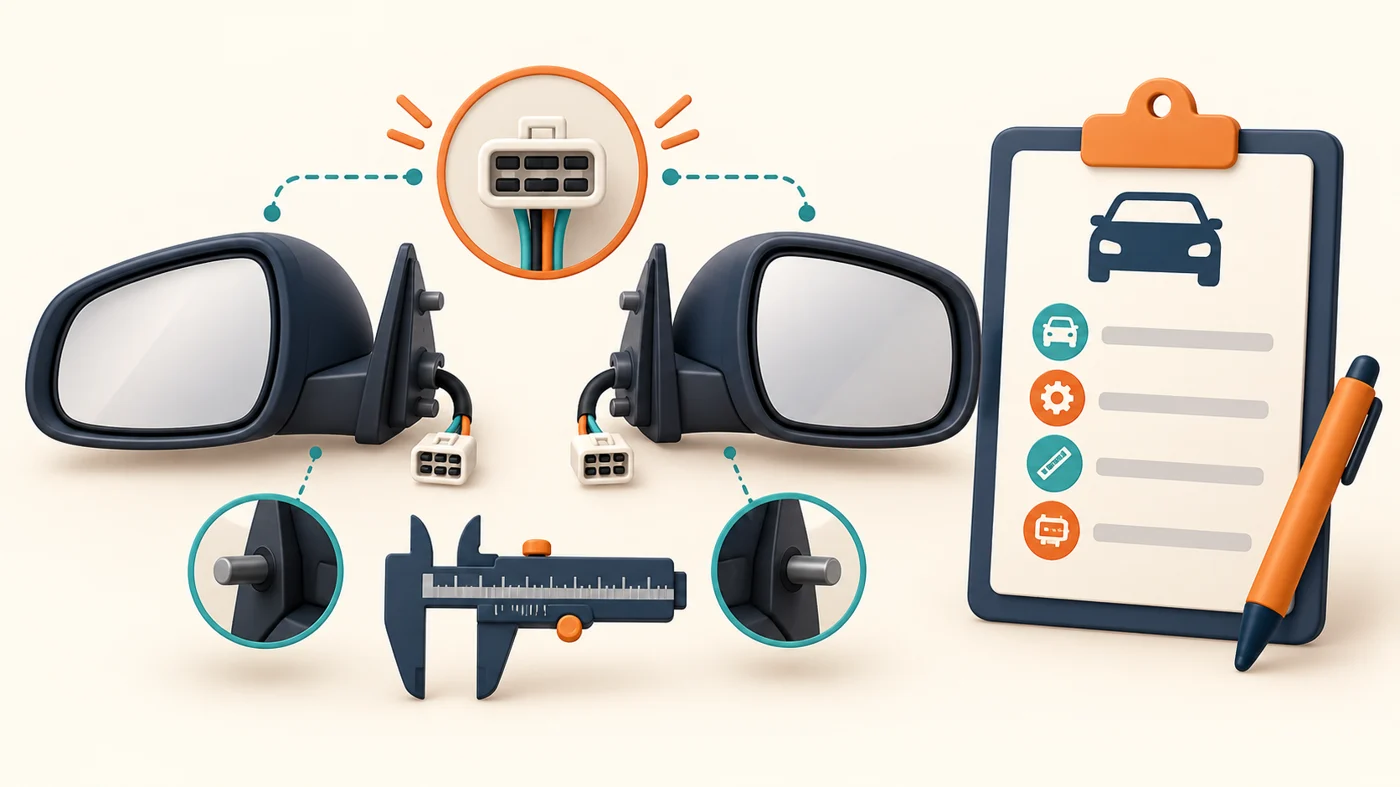
Hypothetical example: request 2 mirror assemblies, one left and one right, with specified features. Two left assemblies meet a total count of 2 but fail the specification. Even a correct left/right pair still needs the confirmed application and feature version. Record each side as a separate row; this example does not claim any real vehicle fitment.
Four separate acceptance records
Four separate acceptance records: Fitment, Identity, Receiving, Technical acceptance
Scroll sideways or use the arrow keys to see all columns.
| Record | Required confirmation |
|---|---|
| Fitment | Vehicle application and version |
| Identity | Maker, condition and provenance |
| Receiving | Approved label, side, accessories, damage |
| Technical acceptance | Qualified installation and any coding/calibration |
Receive the approved code, then verify installation separately
At the warehouse, match maker, full number, labels, side, accessories and visible condition to the approved request. Keep label/connector photos and carton references; compare the actual item, not only an invoice description. Quarantine a mismatch before export and ask the seller for a scoped remedy without assuming return or refund approval.
At destination, have the responsible technician complete the necessary installation and acceptance process under the applicable instructions. Preserve supplier documents and any agreed test evidence. Catalog applicability, authenticity, visible condition and successful technical acceptance are separate records; none should be replaced by a single reassuring photo.
Plan your order
Send your product links, quantities and destination so we can assess your requirements.
Request a sourcing assessment