Handbag materials and hardware: a specification buyers can compare
Specify handbag materials separately for the outer panels, backing, lining, reinforcement, straps and hardware. “Leather bag with silver hardware” leaves the quote open: neither the material structure nor the metal and finish is identified. Write a component specification, compare like-for-like offers and approve a traceable sample before production. A product photograph, brand mark or matching outer dimensions does not prove material, authenticity, load capacity or destination compliance.
Published pending human review of service details and native-language copy. Confirm service terms with JTLGO before ordering.
On this page
Build a material bill for this bag
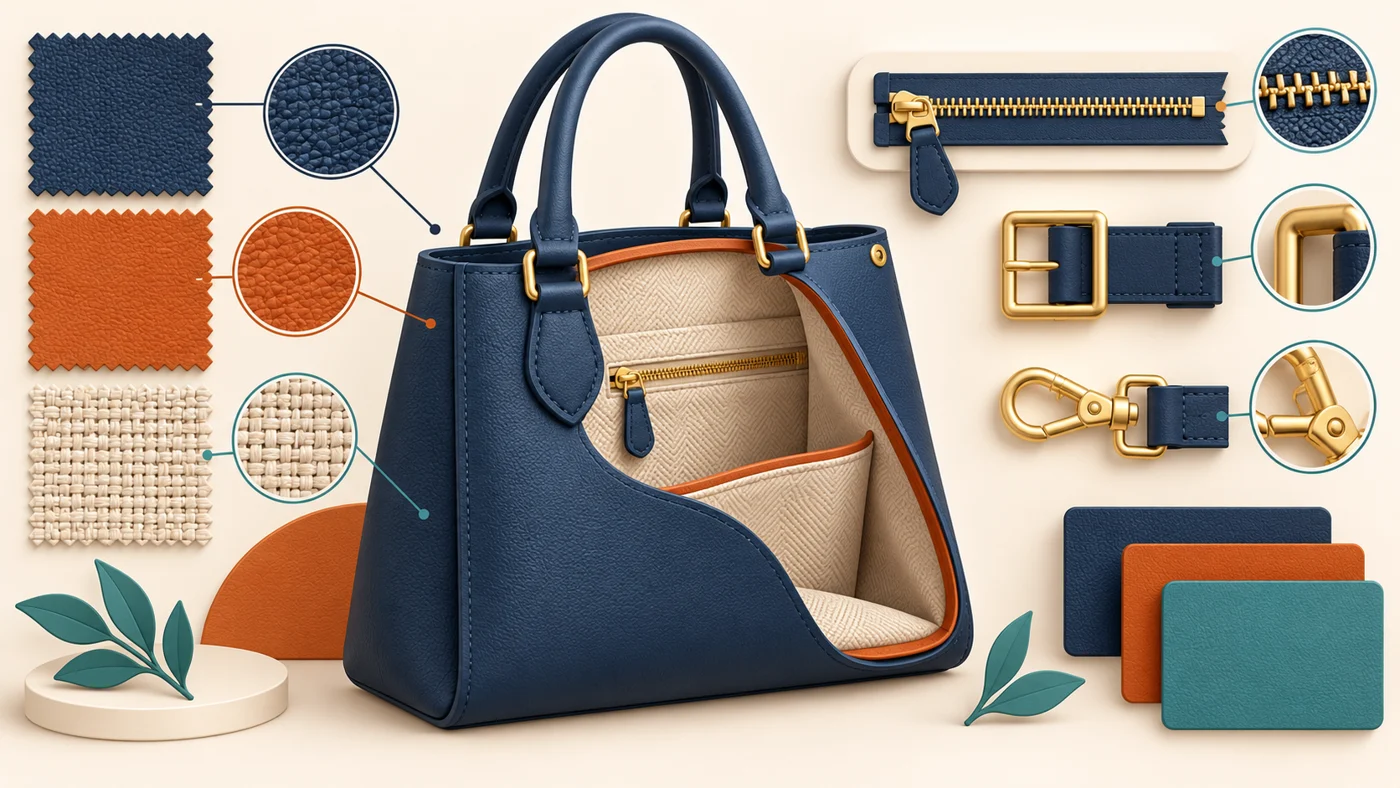
For each outer panel and trim, state the agreed material description, species and grade if actual leather is requested, or coating and backing if a synthetic construction is requested. Add thickness or fabric weight where relevant, physical swatch, grain/texture, colour and finish. State lining composition, pocket fabric, edge construction, adhesive and reinforcement details appropriate to the design. Do not infer these from “genuine”, “premium” or “vegan”. For US marketing, FTC Leather Guides address misleading leather and imitation-leather claims. That pointer does not certify an individual bag or cover every destination rule.
Specify hardware beyond its colour
YKK distinguishes zipper constructions. List zipper type, size/reference, tape and slider; identify pullers, rings, hooks, snaps, buckles, rivets and feet separately. Ask for base material, finish/coating, dimensions, component supplier and approved sample reference. Silver-colour does not mean silver metal, and a logo does not establish authorized components. If a named brand is required, ask for traceable purchasing evidence and model confirmation. Agree replacement approval, not “similar quality”. Compare hardware appearance and operation in the assembled bag, including clearance near lining and straps.
Scroll sideways or use the arrow keys to see all columns.
| Component | Specification/evidence | Approval question |
|---|---|---|
| Outer and backing | Material structure, thickness/weight, swatch/finish | Same agreed construction? |
| Lining and reinforcement | Composition, pocket layout, reinforcement locations | Accessible and traceable? |
| Straps and attachments | Dimensions, construction and agreed use test | Suitable evidence for intended load? |
| Closure | Type/model, tape/slider and operation | No forcing or lining snag? |
| Metal hardware | Base material, finish, supplier and dimensions | Colour alone avoided? |
| Packing | Shape protection, surface separation and carton plan | Final volume confirmed? |
Component approval map
Component approval map: Outer and backing / Material structure, thickness/weight, swatch/finish / Same agreed construction?; Lining and reinforcement / Composition, pocket layout, reinforcement locations / Accessible and traceable?; Straps and attachments / Dimensions, construction and agreed use test / Suitable evidence for intended load?; Closure / Type/model, tape/slider and operation / No forcing or lining snag?; Metal hardware / Base material, finish, supplier and dimensions / Colour alone avoided?; Packing / Shape protection, surface separation and carton plan / Final volume confirmed?
Scroll sideways or use the arrow keys to see all columns.
| Component | Specification/evidence | Approval question |
|---|---|---|
| Outer and backing | Material structure, thickness/weight, swatch/finish | Same agreed construction? |
| Lining and reinforcement | Composition, pocket layout, reinforcement locations | Accessible and traceable? |
| Straps and attachments | Dimensions, construction and agreed use test | Suitable evidence for intended load? |
| Closure | Type/model, tape/slider and operation | No forcing or lining snag? |
| Metal hardware | Base material, finish, supplier and dimensions | Colour alone avoided? |
| Packing | Shape protection, surface separation and carton plan | Final volume confirmed? |
Measure geometry and try the agreed use
Mark how width, height and depth are measured: empty or filled, exterior or usable interior, base or top opening. Record opening width, handle drop, strap range, pocket dimensions and closure position relevant to use. A 30 × 22 × 10 cm exterior does not establish that a particular item fits inside. Test with the agreed contents and load under agreed conditions; do not invent a universal carry-weight or cycle threshold. YKK warns against forcing an overfilled bag’s zipper. Check operation without forcing it; stop and record a jam rather than altering the sample.
Approve evidence and packaging, then control changes
Inspect panel alignment, stitch paths, loose threads, strap attachments, edge finish, lining snagging, sharp hardware, finish differences and closure operation. Photographs show visible condition; composition, coating durability, corrosion, abrasion or attachment strength need appropriate agreed evidence and tests. Ask a qualified provider to define methods and acceptance criteria when those claims matter. Request sample ID, component bill, findings and unresolved items in one record. Specify shape protection, separation of hardware from surfaces, unit bags, labels and carton counts. Packing affects volume; confirm final dimensions before freight.
Hypothetical same-size comparison
Assume both offers state 30 × 22 × 10 cm empty exterior dimensions. A says “leather, silver hardware”; B says “PU-coated textile outer, polyester lining, zinc-alloy rings with silver-colour finish”. They are not a matched material comparison. If your brief requires the latter construction, ask A to requote it and ask B for backing, finish and component evidence. B’s more detailed words are not verification. The dimensions and offers are invented; no price, strength result or supplier approval is assumed.
Copyable handbag specification request
Style/sample/version: [ ]. Outer/backing/lining/reinforcement: [ ]. Material swatches, thickness/weight and finish: [ ]. Empty/filled dimensions and measurement points: [ ]. Opening, pockets, handle/strap: [ ]. Hardware bill, supplier/model and finish: [ ]. Intended contents/load and agreed tests: [ ]. Labels/packing: [ ]. MOQ by colour and substitution control: [ ]. Please list confirmed evidence, pending checks and sample cost separately. No component substitution without written approval.
Claims that need different evidence
Claims that need different evidence: 30 × 22 × 10 cm exterior / Defined measurement points / Does not prove usable fit; Silver-colour finish / Base material and coating evidence / Does not prove silver metal; Brand mark / Traceable authorized component evidence / Does not prove authenticity
Scroll sideways or use the arrow keys to see all columns.
| Component | Specification/evidence | Approval question |
|---|---|---|
| 30 × 22 × 10 cm exterior | Defined measurement points | Does not prove usable fit |
| Silver-colour finish | Base material and coating evidence | Does not prove silver metal |
| Brand mark | Traceable authorized component evidence | Does not prove authenticity |
Retain the accepted reference and component bill for production and reorders. Ask JTLGO to quote the actual sample and inspection scope; basic QC media do not identify chemistry or certify performance. Resolve open evidence before release and check the produced batch against the approved version.
Plan your order
Send your product links, quantities and destination so we can assess your requirements.
Request a sourcing assessmentSources and references
- 16 CFR Part 24 — Leather and Imitation Leather Guides FTC regulation via eCFR
- YKK zipper use guidance YKK
- YKK zipper components and types YKK
- JTLGO inspection scope JTLGO