Agent-to-Agent Commerce in 2026: The Protocol Stack Behind Autonomous Buying
Agent-to-agent commerce, defined
Agent-to-agent commerce is a purchase in which software acting for the buyer negotiates and transacts with software acting for the seller, and a human approves the outcome rather than operating the storefront. The buyer's agent reads a catalogue through a machine interface instead of a product page, asks for a quote instead of filling a form, and carries a signed authorization instead of typing a card number. The term covers both retail checkout and B2B procurement, and the B2B half is where the money is.
What changed between 2025 and 2026 is not that agents became smarter. It is that four protocols shipped, in roughly thirteen months, which together let an agent discover a tool, talk to another agent, prove what its user authorized, and complete a payment. Before those existed, an agent could only imitate a person clicking. Now it can hold a machine-readable conversation with the other side.
The four-layer stack, and what each layer actually solves
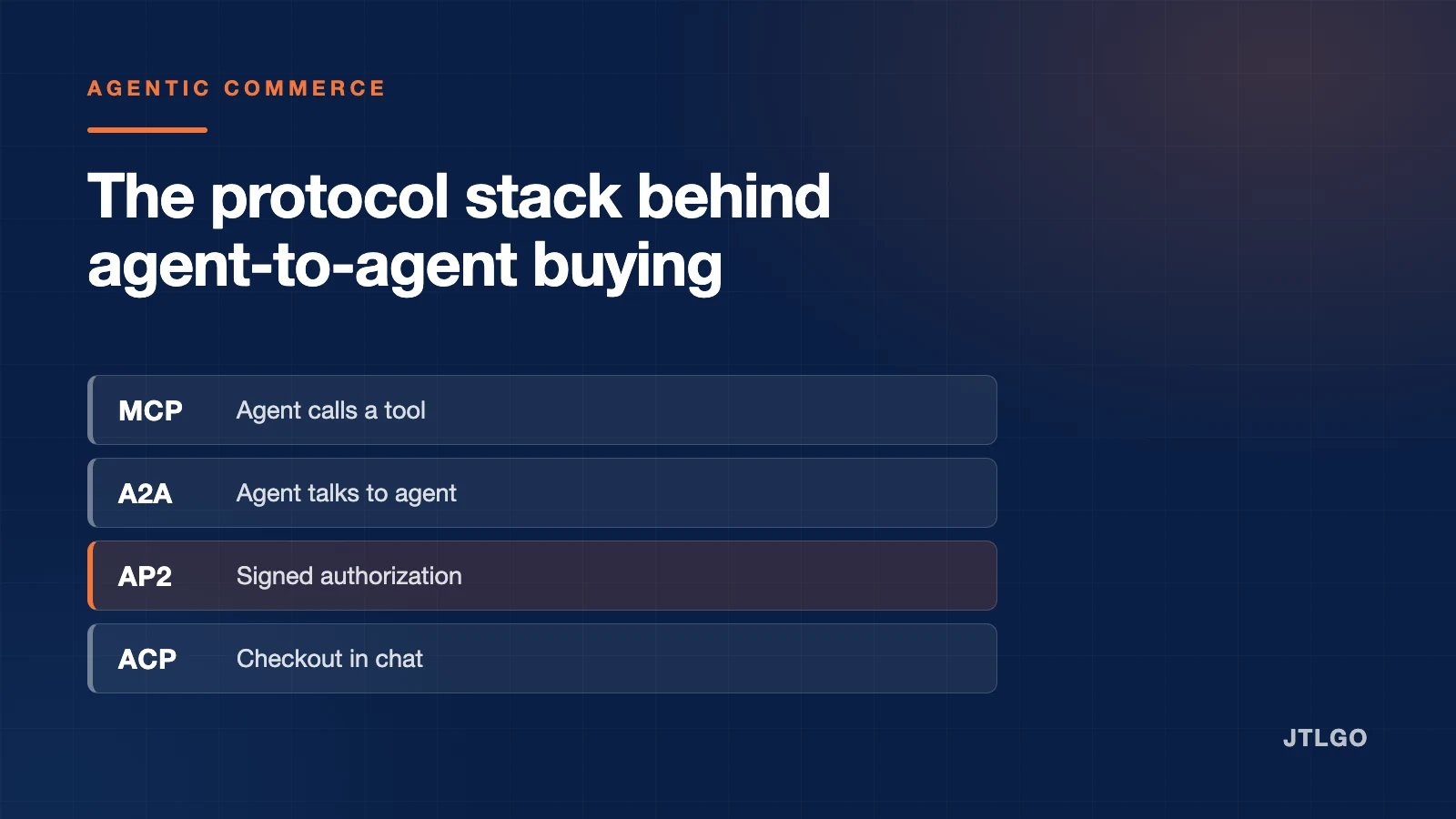
These protocols are often named together as if they competed. They do not. Each one closes a different gap, and a working transaction usually touches several.
| Layer | Protocol | Problem it solves | What it does not do |
|---|---|---|---|
| Agent to tools | Model Context Protocol (MCP) | Lets one agent call a catalogue, a quote engine or a tracking system as typed tools instead of scraping a page | Says nothing about who pays, or about trust between two companies |
| Agent to agent | A2A | Lets two independent agents discover each other's capabilities through an Agent Card and hold a task-shaped conversation | Carries no payment authority and no settlement |
| Authorization | Agent Payments Protocol (AP2) | Proves cryptographically that a named user authorized this intent, this cart and this amount | Does not find products or negotiate terms |
| Checkout | Agentic Commerce Protocol (ACP) | Gives a merchant catalogue and checkout a shape an assistant can complete inside a chat | Is scoped to merchant checkout, not multi-party B2B sourcing |
AP2 is the layer worth understanding in detail, because it is the one that answers the question every finance team asks first. Google announced it on 16 September 2025 with more than sixty launch partners including Mastercard, PayPal, American Express and Coinbase. It introduces three signed artefacts, called Mandates, carried as W3C Verifiable Credentials: an Intent Mandate recording what the user asked for, a Cart Mandate recording what the agent selected, and a Payment Mandate recording what was charged. The merchant ends up holding a tamper-evident chain of evidence rather than an assertion that an agent was probably acting in good faith.
That chain is the whole point. Disputes in agent-mediated purchasing are not really about fraud detection. They are about liability: if an agent bought the wrong thing, was it the user's instruction, the agent's inference, or the merchant's catalogue that was wrong? Signed mandates make that question answerable after the fact.
What the forecasts say, and how much weight to give them
Forecasts for this market vary by more than an order of magnitude, which is itself informative: analysts agree on the direction and disagree on almost everything else. The spread comes from what each one counts. A number that counts B2B spend merely influenced by an agent will always dwarf one that counts only autonomous checkout.
| Source | Figure | Horizon | What is being counted |
|---|---|---|---|
| Gartner (October 2025) | 90% of B2B buying agent-intermediated, over $15 trillion | 2028 | Spend passing through agent exchanges, including agent-assisted |
| McKinsey | $3–5 trillion globally | 2030 | Agentic commerce transaction value |
| Bain | $300–500 billion | US market | Narrower, consumer-weighted definition |
| Morgan Stanley | $190–385 billion | Near term | Agent-completed checkout only |
The Gartner figure is the one being quoted in vendor decks, and it deserves a caveat. "Agent-intermediated" is a wide net. A procurement analyst who asks an assistant to shortlist three suppliers and then signs the contract herself is inside that 90%. Treat it as a statement about how buyers will search, not a claim that nine out of ten purchase orders will be issued without a person reading them.
The more grounded signal is behavioural. IDC reported in August 2026 that eight in ten B2B technology buyers already use AI agents somewhere in their purchasing process. Forrester expects roughly a fifth of B2B sellers to face agent-led quote negotiation by the end of 2026. Those are descriptions of what is already happening rather than projections of what might.
What actually changes for a buyer
Three things change in practice, and they are smaller and more useful than the headline numbers suggest.
Discovery stops being a browsing problem. An agent with catalogue access can compare forty suppliers on the same specification in the time a person compares four, because it is reading structured fields rather than interpreting marketing pages. The bottleneck moves from finding candidates to deciding which fields matter.
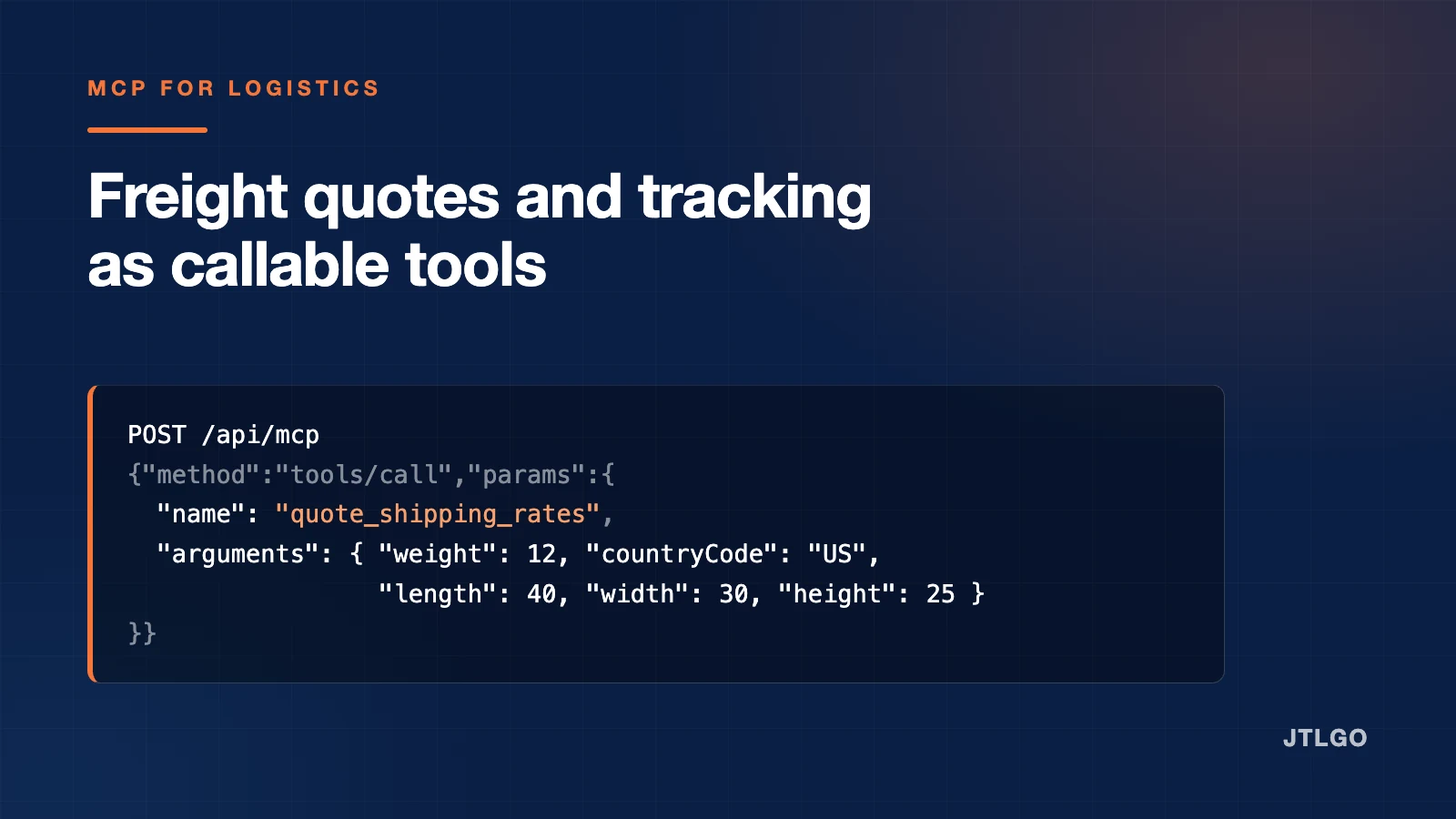
Quotes become a request, not a form. A freight quote, a tiered wholesale price, a lead time: each of these is a function call once the seller exposes it. The buyer's agent can re-run the same call against changed assumptions without re-entering anything, which is why quote comparison is usually the first workflow a company automates.
Approval becomes explicit rather than implied. This is the underrated one. Signed mandates force a company to write down, in advance, what an agent is allowed to commit to. Most procurement teams discover during that exercise that the rules were never written down for humans either.
What is still unsolved
Being honest about the gaps is more useful than another round of forecasts.
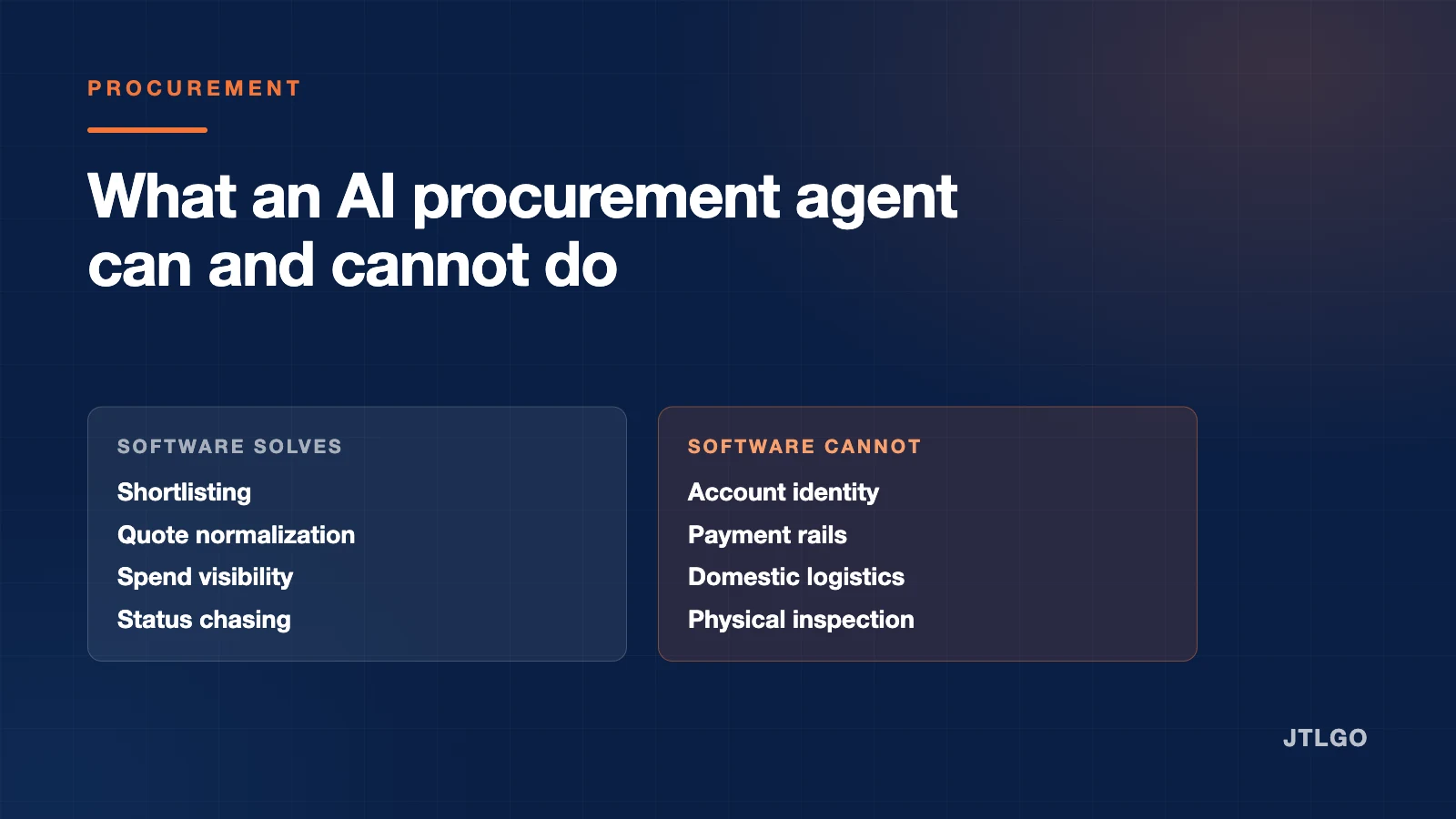
- Cross-border execution. The protocols assume the seller can accept the buyer's payment instrument and ship to the buyer's address. Across a border, and particularly into and out of China's domestic marketplaces, neither assumption holds. This is covered in detail in the companion article on procurement pain points.
- Supplier verification. A signed mandate proves the buyer authorized the purchase. It proves nothing about whether the factory on the other end exists, holds the certification it claims, or will ship what the sample showed.
- Catalogue quality. Agents inherit the data they are given. A supplier whose product records are inconsistent becomes invisible to an agent that filters on structured fields, regardless of how good the product is.
- Discovery incentives. When an agent chooses the shortlist, the question of how a supplier gets into it is unresolved, and every proposed answer so far looks uncomfortably like paid placement in a new costume.
What a seller should do about it now
The defensible move is not to buy an agentic commerce platform. It is to make the data an agent needs available in a form an agent can consume, and to be specific about what it means. Concretely: publish real specifications rather than marketing copy, expose quoting and tracking as callable tools (JTLGO does this through its hosted MCP connector), and state your commercial terms in language that survives being read out of context. Gartner's own framing of the shift is that search engine optimization gives way to agent engine optimization. That is less dramatic than it sounds. It mostly means the same discipline, applied to machine readers who do not scroll, do not infer, and do not give credit for a nice photograph.
Frequently asked questions
Is agent-to-agent commerce the same as agentic commerce?
Close, but not identical. Agentic commerce is the broad term for any purchase where an AI agent acts for the buyer, including one that simply completes a checkout inside a chat. Agent-to-agent commerce is the narrower case where software represents both sides, which is where negotiation and B2B procurement live.
Does MCP compete with the Agentic Commerce Protocol?
No. MCP is how an agent calls a tool. ACP is how a merchant exposes a catalogue and checkout so an assistant can complete a purchase. A single transaction can use MCP to gather information and ACP to pay for it.
Do I need AP2 to let an agent buy something?
Not technically. You need it when you want a record of authorization that survives a dispute. For low-value repeat purchases companies often skip it. For anything a finance team will be asked to defend, the signed mandate is the point.
Which protocol should a supplier support first?
MCP, because it has the widest client support and the lowest commitment. Exposing your product data, quoting and tracking as MCP tools makes you callable by assistants today, and a freight connector is a concrete worked example, and it does not lock you into any one payment scheme.
Sources and references
- Gartner Unveils Top Predictions for IT Organizations and Users in 2026 and Beyond Gartner
- Announcing Agent Payments Protocol (AP2) Google Cloud
- AP2 — Agent Payments Protocol Documentation AP2 Protocol
- Model Context Protocol specification Model Context Protocol