How to Read an Africa DDP Auto Parts Quote
A useful auto-parts shipping quote lets you answer a practical question: what will this shipment cost to reach the agreed destination under the stated conditions? A single freight figure cannot answer that if the parts list, packaging or delivery point is still unclear.
Published pending human review of service details and native-language copy. Confirm service terms with JTLGO before ordering.
On this page
- Quick answer
- First, identify what the number covers
- Understand DDP and the service contract together
- Build a cost checklist with four clear statuses
- Check the physical basis of the freight charge
- Review conditions that can change the decision
- Frequently asked questions
- Request a quote you can evaluate
- Prepare a specific inquiry
Quick answer
First identify what the quoted number covers. Read DDP together with the service terms, check the physical basis of the freight charge, and use a cost checklist with a clear status for each item. Review any conditions that could change your decision before you accept, and ask JTLGO for a quote you can evaluate.
For this step, see Preliminary shipping estimate.
Start by matching the quote to your purchase. Then separate the product cost, the logistics scope and any optional work. This makes it easier to compare offers and decide which unresolved details matter before you pay.
JTLGO provides broad Africa DDP coverage, with South Africa DDP now available. The applicable quote still depends on the cargo and delivery location.
First, identify what the number covers
Check that the quote names the correct item-list version, quantities and condition. New brake components, used assemblies and battery-containing products should be described accurately rather than grouped under a vague “spares” label.
Confirm the origin and final delivery place. A country name is too broad to establish the delivery scope. The receiving city, postcode and address type should match your request, with the precise address agreed before final confirmation.
Also distinguish a preliminary estimate from a quote based on measured packages. Ask which inputs remain provisional and what event will trigger remeasurement or repricing. Keep the initial and revised versions so changes can be compared line by line.
Understand DDP and the service contract together
Under Incoterms® 2020 DDP, the seller handles export and import clearance and bears the applicable duties and taxes. Delivery occurs at the named place with the goods ready for unloading. The ICC Academy's DAP and DDP explanation sets out those responsibilities.
Incoterms describe buyer and seller obligations in a sale. A logistics provider may separately quote transport using the label DDP, so ask how that service fits the purchase contract and who performs each role. If a quotation shifts import duty or clearance back to you, have the inconsistency clarified before treating it as a conventional DDP offer.
DDP also does not automatically provide a cargo-insurance policy or unloading service. The ICC Academy's insurance and unloading discussion explains why these need careful treatment. Ask for the actual service and insurance terms rather than assuming that one label answers every question.
JTLGO’s current optional cargo insurance is Loss Only and does not cover damage. Confirm the applicable cover, exclusions and claim process before dispatch. See the cargo insurance and claims policy.
Build a cost checklist with four clear statuses
For each cost below, mark it “included,” “separate,” “not applicable” or “awaiting confirmation.” A blank entry leaves room for misunderstanding.
- Goods: item prices, quantities, selected variants and currency
- Purchasing support: any sourcing or buying fee and its calculation basis
- Origin movement: supplier delivery, collection or transfer to the dispatch warehouse
- Warehouse work: receiving, storage, consolidation and any specifically requested checks
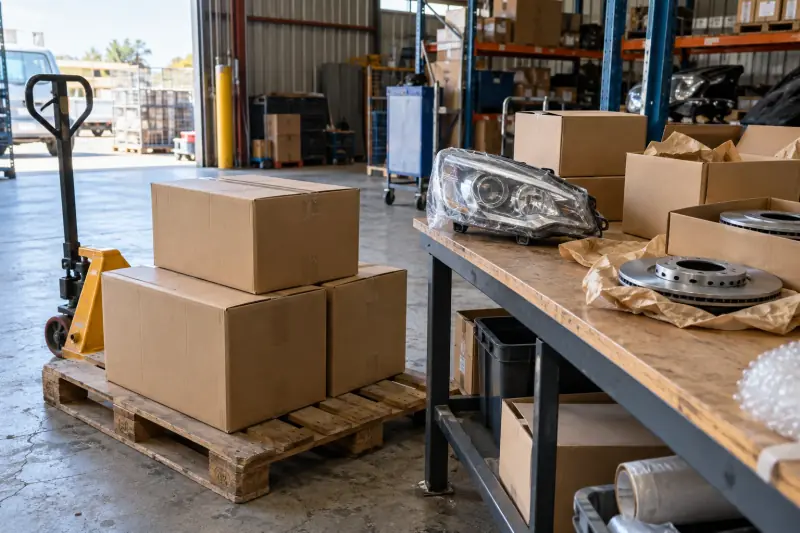
- Packaging: cartons, protective materials, crates, pallets or repacking
- Transport: quoted mode, chargeable basis and named delivery destination
- Customs: clearance arrangements, duty and import-tax treatment, required product documentation
- Delivery: final-mile service, address restrictions, appointments and special handling
- Optional protection: cargo insurance, insured value, deductibles and exclusions where offered
- Conditional costs: inspection, additional storage, redelivery or other stated events that could change the amount
Ask who authorizes additional work and how its price will be communicated. Do not assume every possible conditional cost will arise, but do not treat an undefined exception as a settled amount either.
Check the physical basis of the freight charge
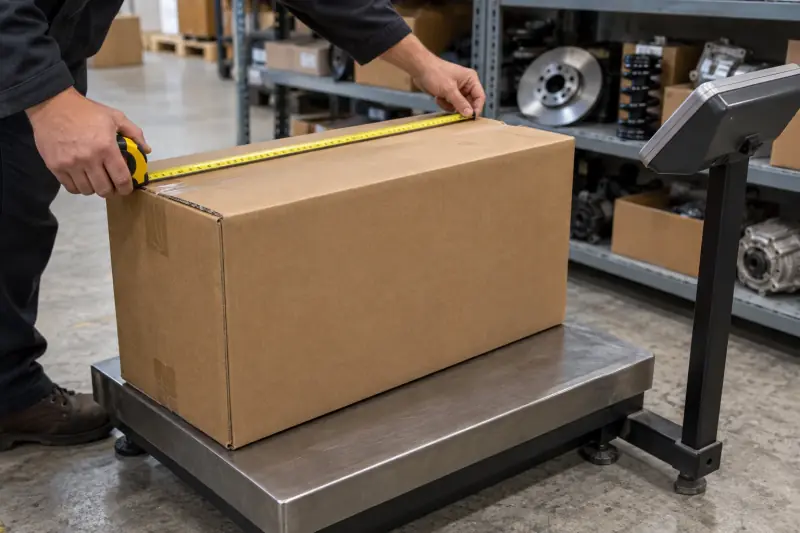
Auto parts create very different handling demands. A large bumper can occupy substantial space, while a compact assembly can be heavy. Crates and protective supports also change the shipment's external dimensions and gross weight.
Request package count, dimensions and gross weight for the packed shipment. Ask which charging rule applies to the proposed route, including any minimum charge or oversized-piece treatment. Avoid using a generic volumetric conversion found online unless the provider confirms it for that service.
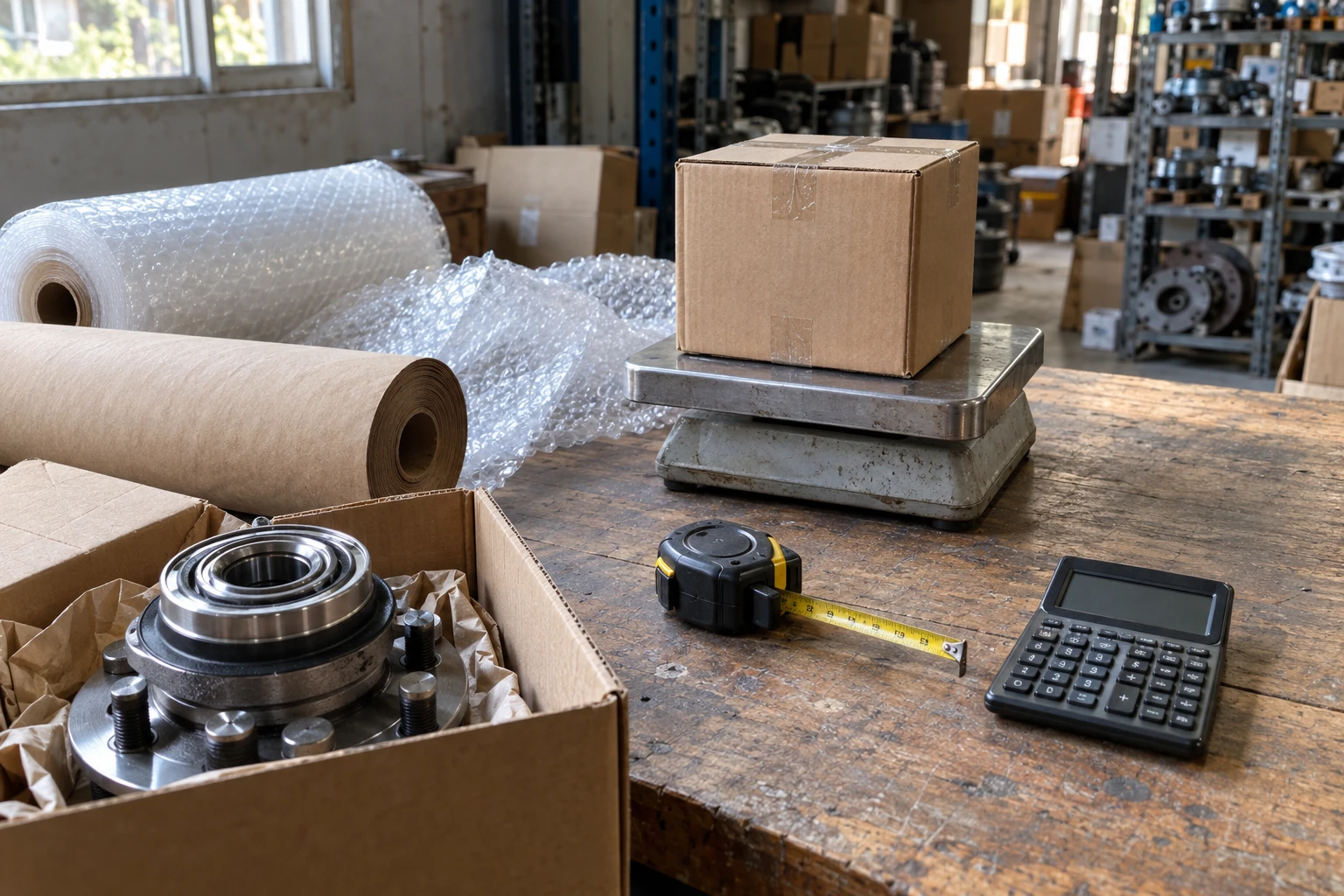
If repacking is proposed, compare the expected protection, handling cost and revised measurements together. Reducing volume is useful only when the resulting package remains suitable for the cargo. Ask whether a final measurement will be available before you approve dispatch.
Review conditions that can change the decision
Read the quote's validity period and cargo-ready assumptions. If timing is important, ask what the estimated transport period includes and when it begins. Supplier preparation, document review and final delivery arrangements may be separate stages.
Confirm the lawful importer and customs-declaration arrangement. If tax records are important for your business, ask which documents can be provided and seek advice on your own accounting treatment; the words “duty paid” do not establish your entitlement to recover tax.
Finally, compare alternatives using the same cargo list and destination. A lower total based on fewer services or provisional measurements is a different offer. Resolve those differences before selecting the headline price.
Frequently asked questions
Does a DDP freight quote include the purchase price of my parts?
Only if the quotation explicitly includes the goods. Purchasing and freight can be quoted separately. Match each payable amount to its purpose to avoid counting a cost twice or leaving it out.
Should every possible additional charge be included upfront?
Ask for known mandatory costs and clearly described conditions for uncertain events. If a material cost is still unknown, understand who will confirm it and whether you can decide before the relevant work proceeds.
Can the price change after packing?
It can if the initial amount depended on estimated measurements or other assumptions that change. Request the actual measurements, applicable pricing rule and explanation for the revision.
Request a quote you can evaluate
Send JTLGO your auto-parts list and destination and ask for the applicable DDP scope. Include packed measurements if available, label estimates clearly and list any purchasing, packing, insurance or unloading needs that should be priced separately.
Prepare a specific inquiry
Prepare the item list, quantities, pickup location, carton count, packed dimensions and weight, destination and deadline. Rate & Ship is a preliminary estimate. Ask for manual confirmation of the full charge scope before committing to complex cargo.